

We are convinced that CTC is the next generation of model railway control. That is why we also refer to the "old" or "classical" digital when it comes to DCC, Motorola format (MM) or Märklin mfx, etc.
Since we cannot develop CTC modules for all conceivable applications as quickly as we would like and, on the other hand, want to give our customers a smooth transition to CTC, this chapter deals with the various bridges between CTC and old digital systems.
An overview of the possibilities is provided by our short film series "Integrating digital technology into CTC" on our social media channels:
  
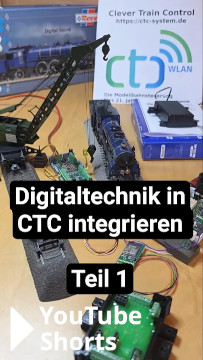
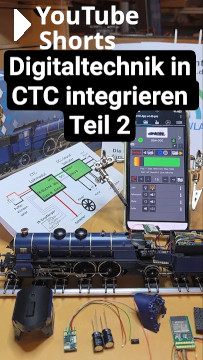
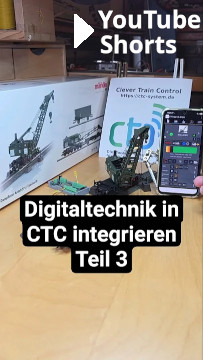
Currently, there are the following ways to connect CTC with the old digital world:
- Parallel operation: CTC locos also run on digital current, so they can run on the same tracks as locos operated by old digital systems at the same time. In this case, the controls of both worlds are completely separate for the time being, but can be merged in a model railway control software.
- Connecting loco decoders: DCC loco decoders can be connected to the motor output of a CTC loco module and thus controlled via CTC. This allows beloved sound decoders to continue to be used with CTC, provided there is enough space for the additional CTC module in the loco.
- Connecting accessory decoders: DCC accessory decoders (turnouts, signals, etc.) can be connected to CTC turnout modules with half bridges and thus switched via the CTC app and integrated into automations. The number of accessory decoders that can be connected to a CTC module depends only on their power consumption.
- Remote control of Z21 central unit: From version 4.05 onwards, CTC can communicate with digital control units such as the Z21 from Roco via the Z21-LAN protocol . This allows classic digital locomotives, turnouts, etc. to be remotely controlled via a digital control unit with Z21-LAN protocol using the CTC app.
- Integrating Z21 handheld controllers: Also from version 4.05 onwards, CTC can behave like a digital control unit with Z21-LAN protocol. This allows handheld controllers such as the Z21 WiFi mouse from Roco to be used to control CTC locos and switch CTC turnouts.
- Model railway control software: Also with the help of the Z21-LAN protocol and, in the near future, directly with iTrain, it is possible to integrate CTC like a digital control unit into model railway control software.
For all bridges to the old digital world, it naturally applies that CTC can only partially exploit its strengths. You will only get rid of the technical limitations of the old digital world when you switch completely to CTC.
Parallel operation
There is not much to say about parallel operation. CTC modules can be operated with up to 24V DC, digital current and also AC current. For more information, see the separate document "Power supply and router" .
In this scenario, the old digital locos and turnouts are controlled as before and the CTC modules via the CTC apps. A direct connection between the two worlds is not provided in this scenario, but can be created with the help of model railway control software such as iTrain (see Chapter 8.4 ).