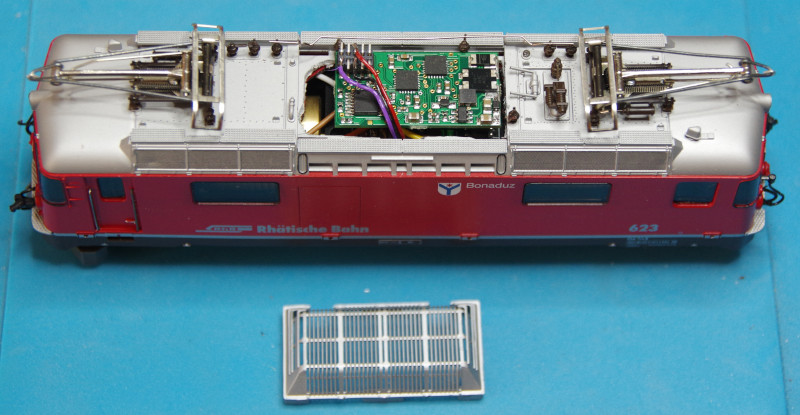





On our trade fair stand, the H0m gauge should not be neglected either. For this purpose, I acquired a starter set from Bemo on eBay and then converted the locomotive contained therein to CTC.
The enclosed documentation clearly shows how to disassemble the locomotive. First, the two couplings are removed. Then the four clips hidden in the side wall can be opened and the housing pulled upwards.
In the picture, I have already removed the roof structure, as the CTC module will later find its place there:
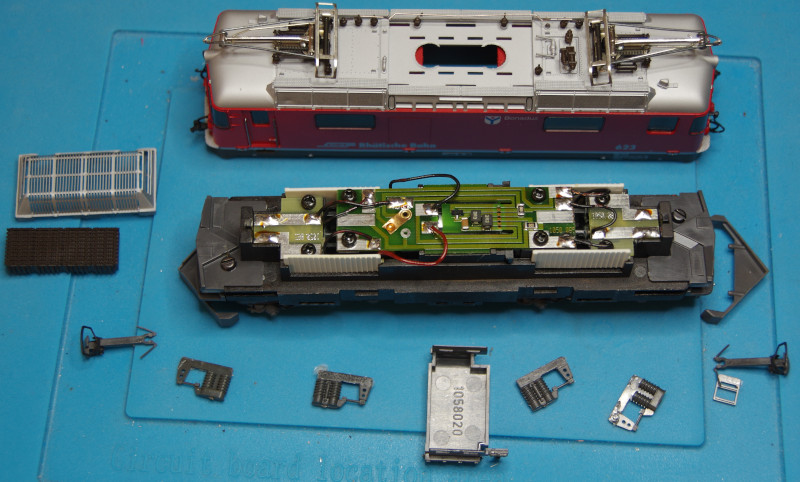
After some pondering, I decided to remove the locomotive circuit board. Unfortunately, this also holds the motor in place, so suitable replacement is required. A PluX22 adapter, which I had acquired on eBay, fortunately had suitable screw holes. Although I could only use two of the four screws from the old circuit board, the motor is fixed well enough this way. The picture shows the locomotive with the CTC-Loco-Module-PluX22 already installed. The support capacitor fills the rear driver's cab:
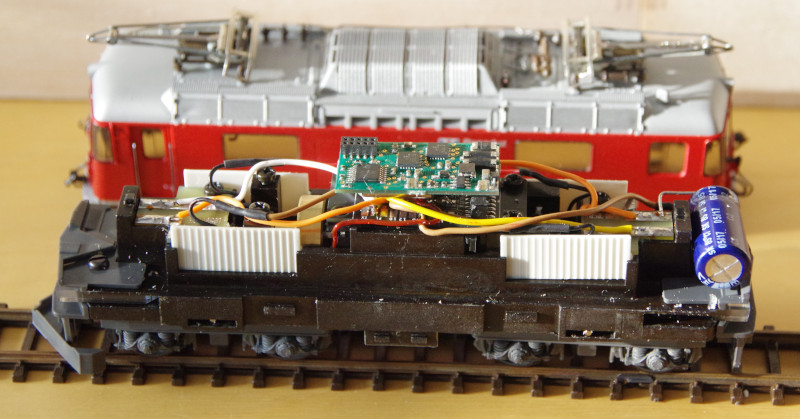
As is often the case with analog locomotives, one pole of the front and rear lighting was connected via the housing. I cut this connection at the respective circuit boards using a cutter knife. The separation points can be seen in the photo directly next to the solder point of the orange wire:
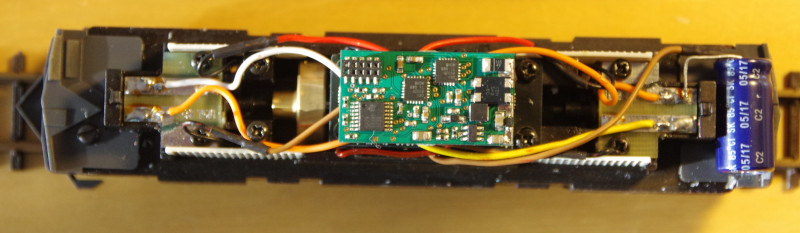
For the IR receiver, I removed the central floor panel and drilled a 3mm hole through the housing. Then I could feed the cable through, solder the IR receiver and finally glue it onto the locomotive housing:
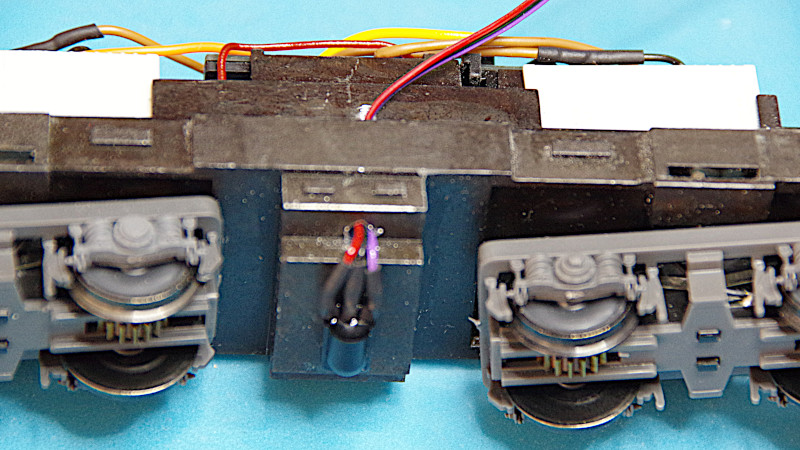
Now all that was left was to plug the cable of the IR receiver into the CTC-Loco-Module-PluX22:
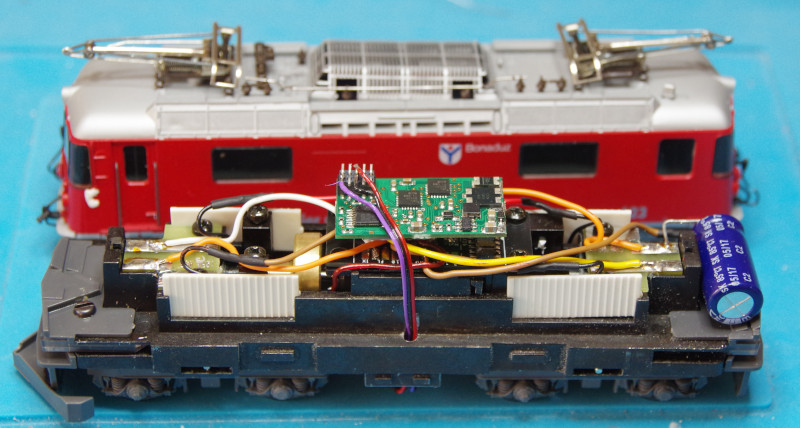
Then came the ugly part: the housing below the roof structure had to be cut open far enough for the locomotive module to fit through. With a different PluX22 adapter, which has a lower socket, the roof structure could also be fitted neatly again. For my trade fair locomotive, the roof structure is left off entirely, allowing an unobstructed view of the CTC-Loco-Module-PluX22: