




Switching from digital control to CTC is particularly worthwhile if the model railway is to continue growing.
Another reason for switching to CTC can be the IR beacons, which offer clear advantages in position detection of locomotives and automatic control.
What do you need for CTC?
- A power supply: This will initially be the digital control unit or the booster.
- A WiFi access point : For initial tests, your private WiFi will suffice. From around 20 modules onwards, however, a dedicated WiFi network for the model railway should be used.
- One CTC-Loco-Module for each locomotive.
- For turnouts and signals, either one CTC-Turnout-Module each or a CTC-Multi-I/O-Board for up to 4 turnouts/signals.
Parallel operation of digital locomotives/turnouts/signals and CTC locomotives/turnouts/signals is possible at any time. Control is then separate via the digital control unit and the CTC app. A connection of both worlds in one control system will only be possible when model railway control software also supports CTC.
What happens to my digital decoders?
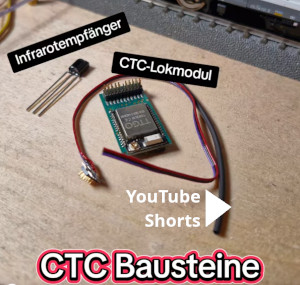
The digital decoders are replaced by corresponding CTC-Loco-Modules .
For locomotives with sophisticated sound decoders, it is also possible to place the CTC-Loco-Module between the track and the sound decoder. However, this requires that the locomotive has enough space for both the digital decoder and the CTC-Loco-Module. This is often not the case, especially in steam locomotives.
How do I get started?
The easiest way is to order a starter set from us to familiarize yourself with the new world of CTC. You can start with either a turnout, a locomotive, or both.
In any case, you will receive a CTC-Router, the CTC modules, and the CTC app. You don’t need anything else, as the power supply is provided by your existing digital control unit or booster. CTC locomotives can run on the same track as digital locomotives at the same time. Turnouts can be powered with digital current or a separate power source.
And how do I proceed?
There are various options:
- You gradually convert all locomotives, turnouts, and signals to CTC and eventually achieve a purely CTC-controlled model railway.
- You only convert turnouts, signals, and feedback devices to CTC and continue to operate your locomotives digitally.
- You only convert your locomotives to CTC and optionally install CTC-IR beacons in the track, but continue to operate digitally.
Support for CTC by model railway control software will come, enabling almost any combination of classic digital and CTC. However, we will do everything we can to convince you of a purely CTC-operated model railway.
What happens to my feedback devices?
With CTC, feedback becomes much simpler: The feedback bus is completely eliminated. Up to four sensors can be connected to the CTC-Multi-I/O-Board.
However, it is worth taking a look at the CTC-IR-Balises . Up to two of them can be connected to a CTC-Turnout-Module or CTC-Multi-I/O-Board. They enable the locomotive to determine its position and optionally receive a command (e.g., signal stop at 70 cm distance). Using CTC-IR-Balises allows simple automation without any intervention from the app.
In all cases, the mentioned feedback information together with the status messages of the CTC modules is transmitted via WiFi.
For more information on automation, see the article Automated driving .